TRAINING PRACTICAL INTERNAL CORROSION CONTROL AND MONITORING IN OIL & GAS OPERATIONS
TRAINING PRACTICAL INTERNAL CORROSION CONTROL AND MONITORING IN OIL & GAS OPERATIONS
Training Praktik Pengendalian Dan Pemantauan Korosi Internal Dalam Operasi Minyak & Gas
Training Internal Corrosion Control As A Key Factor To Pipeline Integrity Management
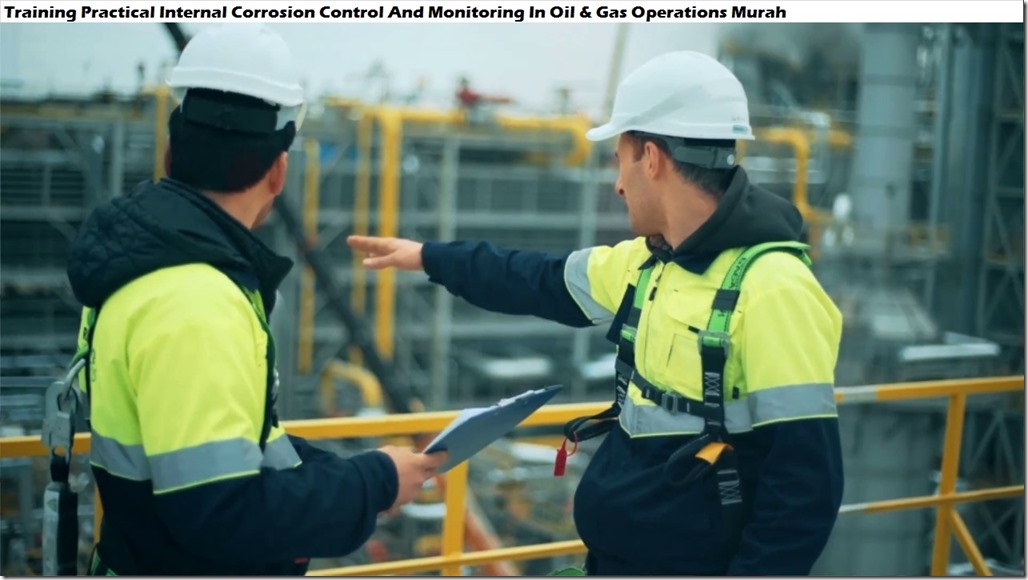
Internal Corrosion Problems in Gas, Oil and Produced Water Pipeline and Equipment
* Piping and Pipeline Leakage due to Pitting Corrosion and Microbiological Induced Corrosion
* Severe Pipe Wall Thickness Reduction and Short Remaining Service Life caused by Sour Corrosion
* Pipe Wall, Rotating Parts and Equipment Cracking due to Chloride and Sulfide in the Fluids
* Internal Corrosion of Pipeline and Equipment due to Water in Oil and Oil in Water Emulsions
* Internal Corrosion due to Multi Phase Flow in the Pipeline
* Severe Corrosion Rate caused by CO2 and Hydrate in the Gas Lines, CO2/H2S Removal Unit and Glycol Dehydration Unit
* Internal Corrosion in the Water Lines due to Dissolved Oxygen, Mud and Sludge
* Malfunction of Pump, Compressor, Valves and Equipment due to Under-Deposit Corrosion, Under-Film Corrosion and Fouling
The Nature, Mechanism and Characteristics of Internal Corrosion and the Control Methods
* Anodic-Cathodic Reactions, Electrical Properties and Characteristics of Corrosion Cells
* Physical & Metallurgical Conditions of Metals and Chemical Composition that Promote Corrosion
* Destructive and Catastrophic Effects of Corrosive Agents and Microorganism in the Gas, Oil and Produced Water Fluids
* The Role and Mechanism of O2, CO2, H2S, Dissolved Salts and Microorganism in Internal Corrosion
* The Role of Oilfield Bacteria and the Mechanism of MIC
* Characteristics and Detection of Internal Corrosion in the Pipeline and Surface Equipment
* Removal of Dissolved Corrosive Agents and Non-Hydrocarbon Gases in the Gas, Oil and Produced Water Fluids
* Internal Corrosion Control with On-line Chemical Inhibitors Injection, Surface Barriers and Scavengers
Internal Corrosion Detection and Monitoring Techniques, Devices and Analysis
* Visual Inspection and Early Detection Techniques & Devices for Monitoring Fluid Corrosiveness and Tests for Identifying Corrosion products
* The Important of Internal Corrosion Rate Monitoring Before and After Chemical Injection and Treatment
* NACE Standard Method for Preparation, Installation, Laboratory Analysis and Interpretation of Results of Internal Corrosion Monitoring
* Access Fittings, Retrievers, Corrosion Coupons, Scale Coupons, Corrosion Probes, Holders, Injection & Sampling Devices and Instrument for On-line Internal Corrosion Monitoring
* The Use of Nipple or Spool, Hydrogen Probe and Galvanic Probe
* NACE Standard Method for Testing and Analysis of Bacterial Activity and Microbiological Induced Corrosion
* Iron Content Analysis of Produced Water and the COPRA Correlation
* Down-hole Tubing or Casing Calipers, Ultrasonic Wall Thickness Testers and Radiography
Internal Corrosion Control with Chemical Inhibitor Injection, Passive Film Formation and Biocides
* Nature & Classification of Inhibitors and Effect of Ionic Character on
* Inhibiting Ability
* Formulations of Oilfield Inhibitors and the use of Water Soluble Inhibitors, Volatile Inhibitors and Acid Inhibitors
* Typical Corrosion Inhibitors, Scavengers & Biocides for Oil & Gas Field
* Guidelines of Inhibitor and Biocide Applications and the Chemical Injection Equipment for Pipeline and Surface Facility
* Inhibitor and Biocide Batch Treatment Using Pigs, Chemical Dosage and the Pigging Operations
* Surfactant and Cleaners for Solving Fouling Problem in the Equipment and Systems
* Cationic & Mixed Charge Organic Inhibitors for Hydrocarbon and Oxygen Corrosion Inhibitors for Produced Water
* Testing and Evaluation of Inhibitor and Biocide Effectiveness
* Safety Precaution in Working with Inhibitors and Biocides
Internal Corrosion Control as a Key Factor to Pipeline Integrity Management
* Hazard Assessment and Risk Based Inspection for the Pipeline and Equipment Maintenance Program
* Pipeline Internal Damage Record and Wall Thickness Monitoring
* Pigging for Water and Deposit Removal from the Pipeline System
* Controlling of Flow Stability and Corrosion Rate to a Safe Level
* Estimating Present Pipeline Remaining Service Life
* Evaluation of Present Condition and Comparison with Initial Pipeline Design Baseline
* Evaluation and Controlling of Chemical Inhibitor and Biocide Injection by using Corrosion Rate Monitoring Data.
* Evaluation of Pipeline and Equipment Damage in accordance with Root Cause Failure Analysis
* Development of Specific Pipeline Integrity Management System by using Internal Corrosion Rate Monitoring Data
Course Leader: Hilman Ahmad
This specially designed course will be conducted by Hilman Ahmad & Associates, an Independent Consultant in industrial oil and gas, member of the Society of Indonesian Petroleum Engineers, who manage the Professional Industrial Oil & Gas Education Center, and has been practicing production operation & safety and corrosion control engineering in Indonesia for more than twenty-five years. He post-graduated from Tokyo Institute of Technology (sponsored by UNESCO) in 1977. He joined in-field-practice program at Nippon Kokan Steel Company & Research Center Kawasaki, Japan for production facility design & construction and corrosion prevention & control in 1983, and collaborated with Cormon Industrial Research Center Brighton UK for on-line corrosion monitoring development in 2000. He has been delivering training course in production operation, maintenance & safety and corrosion control for personnel from Oil & Gas Company and Petrochemical Industry since 1979.
General Information
Facilities
* Quality training material (hardcopy and softcopy)
* Quality training kits included calculator, T-shirt or jacket, cap, ect.
* Convenient training facilities with four star quality
* Morning and afternoon coffee breaks and lunch for along the training
* Certificate of Completion
* Exclusive flash disk.
Jadwal
training practical internal corrosion control and monitoring in oil & gas operations terbaru :
§ 23 sd 24 Januari 2019
§ 13 sd 14 Februari 2019
§ 20 sd 21 Maret 2019
§ 17 sd 18 April 2019
§ 28 sd 29 Mei 2019
§ 25 sd 26 Juni 2019
§ 16 sd 17 Juli 2019
§ 15 sd 16 Agustus 2019
§ 17 sd 18 September 2019
§ 22 sd 23 Oktober 2019
§ 20 sd 21 November 2019
§ 19 sd 20 Desember 2019
Catatan : Jadwal tersebut dapat disesuaikan dengan kebutuhan calon peserta
Biaya dan Lokasi training practical internal corrosion control and monitoring in oil & gas operations terupdate :
Lokasi :
Yogyakarta, Hotel Dafam Malioboro (6.000.000 IDR / participant)
Jakarta, Hotel Amaris Tendean (6.500.000 IDR / participant)
Bandung, Hotel Golden Flower (6.500.000 IDR / participant)
Bali, Hotel Ibis Kuta (7.500.000 IDR / participant)
Lombok, Hotel Jayakarta (7.500.000 IDR / participant)
Catatan : Biaya diatas belum termasuk akomodasi/penginapan.
Investasi training internal corrosion control as a key factor to pipeline integrity management murah :
Investasi pelatihan selama tiga hari tersebut menyesuaikan dengan jumlah peserta (on call). *Please feel free to contact us.
Apabila perusahaan membutuhkan paket in house training, anggaran investasi pelatihan dapat menyesuaikan dengan anggaran perusahaan.
Fasilitas training internal corrosion detection and monitoring techniques murah :
1. FREE Airport pickup service (Gratis Antar jemput Hotel/Bandara)
2. FREE Akomodasi Peserta ke tempat pelatihan .
3. Module / Handout training praktik pengendalian dan pemantauan korosi internal dalam operasi minyak & gas terupdate .
4. FREE Flashdisk .
5. Sertifikat training practical internal corrosion control and monitoring in oil & gas operations terupdate .
6. FREE Bag or bagpackers (Tas Training) .
7. Training Kit (Dokumentasi photo, Blocknote, ATK, etc) training internal corrosion control as a key factor to pipeline integrity management terbaru .
8. 2xCoffe Break & 1 Lunch, Dinner .
9. Souvenir .